
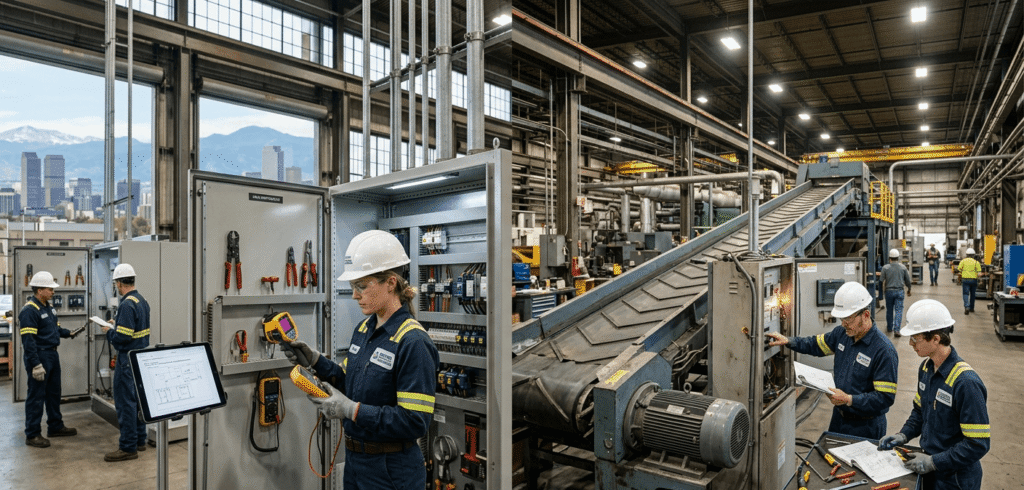
Planned electrical maintenance means scheduling inspections and replacing parts before problems happen, which helps prevent equipment failure and downtime. Emergency maintenance, on the other hand, is needed when unexpected issues stop production and require urgent, often expensive repairs.
For Denver industrial facilities, planned maintenance prevents most emergencies by fixing wear, overheating, and system errors early. A hybrid strategy minimizes downtime while preparing for local risks. To best protect your facility, work with a specialized industrial electrician in Denver for both regular inspections and rapid emergency response.
Why Industrial Electrical Maintenance Is a Unique Challenge in Denver
Denver’s industrial sector covers food and beverage plants, oil and gas sites, pharmaceutical companies, manufacturing, and water treatment. Many of these run around the clock and depend on reliable electrical systems for automation, refrigeration, and production. Even short outages can disrupt work and create safety hazards.
Industrial electrical systems use motor controls, PLCs, DCS systems like Emerson Delta-V, and high-voltage equipment, all of which need special skills to maintain. Denver’s high altitude and changing temperatures put extra stress on electrical parts, causing more wear on breakers, insulation, and connections over time.
What Is Planned (Preventive) Electrical Maintenance?
Planned electrical maintenance means scheduling inspections, tests, and servicing at set times or after certain usage to spot wear before it causes breakdowns or downtime. Most facilities do this work during weekends, holidays, or shift changes to avoid interrupting production.
Planned maintenance activities commonly include:
- Panel Inspection: Checking for overheating, corrosion, and damaged components.
- Connection Torque Checks: Tightening electrical connections to reduce overheating and arc fault risks.
- Dust Removal: Cleaning equipment to improve airflow and system performance.
- Thermal Imaging: Using infrared scanning to identify hidden hot spots and overloaded circuits.
- Load Testing: Evaluating system performance under operating demand.
- Breaker Testing: Confirming breakers respond correctly during faults.
- Motor Maintenance: Inspecting motors for overheating, vibration, and insulation wear.
- Equipment Labeling: Updating safety labels and circuit identification.
These preventive steps help facilities run more reliably, make equipment last longer, and cut down on unexpected shutdowns.
What Is Emergency Electrical Maintenance?
Emergency electrical maintenance means making repairs after a sudden failure, fault, or safety issue stops operations. In industrial settings, even brief outages can stop production, damage automation, spoil inventory, or raise OSHA safety risks. Quick response is crucial for facilities that run all day and night.
Common emergency maintenance triggers include:
- Tripped Breakers may indicate overload conditions or equipment faults.
- Blown Fuses can interrupt critical production systems and automation equipment.
- Motor Failures often result in halted manufacturing operations.
- Arc Faults create serious fire and electrical safety risks.
- Power Surges can damage PLCs, automation systems, and sensitive controls.
- Equipment Shutdowns may signal deeper electrical failures.
- Burning Smells or Smoke often indicate overheating components or insulation failure.
Facilities that operate nonstop should have emergency repair services available to keep downtime low and avoid expensive losses.
Planned vs Emergency Electrical Maintenance
Planned and emergency electrical maintenance each have their own role in industrial operations. Preventive maintenance lowers risk, while emergency response helps facilities bounce back after sudden problems.
| Factor | Planned Maintenance | Emergency Maintenance |
| Timing | Scheduled during off-peak hours, weekends or holidays | Performed after unexpected failures |
| Cost | Predictable fixed-rate agreements | Higher labor premiums and expedited parts costs |
| Operational Impact | Minimal disruption coordinated with production schedules | Significant production interruption and idle workforce |
| Equipment Longevity | Helps extend asset lifespan through early wear detection and proactive repairs | Reactive repair after failure occurs |
| Safety Risk | Controlled maintenance environment | Higher risk during active fault conditions |
| Compliance | Supports OSHA 1910 Subpart S (electrical safety), OSHA 1910.147 (lockout/tagout) and NFPA 70E readiness | Increased compliance exposure if undocumented |
When Emergency Response Is Unavoidable (And What to Do)
Even with good preventive maintenance, facilities can still face unexpected failures from bad weather, old equipment, supply chain issues, or sudden breakdowns. Having a clear response plan helps keep people safe and shortens recovery time during outages.
When an electrical emergency occurs, facilities should take the following steps:
- De-Energize the Affected Circuit: Shut down the affected system if it can be done safely.
- Contact a Denver Industrial Electrician: Request immediate emergency response support.
- Document the Failure: Record photos, timestamps, and affected systems for maintenance records.
- Avoid DIY Repairs: Industrial-voltage systems should only be repaired by qualified professionals.
- Conduct Root Cause Analysis: Identify the underlying issue after repairs to help prevent recurrence.
A clear emergency response plan helps industrial facilities get back to work safely and lowers the chance of repeat problems.
Building a Maintenance Strategy: Planned and Emergency Together
The best maintenance programs mix preventive care with emergency support. Regular inspections reduce the risk of failures, and emergency support provides backup when surprises occur.
With a service agreement from MV Power Solutions, your facility gets both routine maintenance and quick emergency support from skilled Denver industrial electricians.
A balanced maintenance strategy often includes:
- Monthly: Panel inspections, breaker testing, and connection torque verification.
- Quarterly: Thermal imaging, motor inspections, and load balancing reviews.
- Annually: Full electrical audits, code compliance reviews, and arc flash analysis.
- Ongoing: Emergency hotline access and parts stocking support.
- Dedicated Support: Assigned account management for maintenance scheduling and emergency coordination.
This combined maintenance approach helps industrial facilities stay up and running, meet regulations, and save on repair costs.
Industries in Denver That Most Need a Structured Electrical Maintenance Program
Many Denver industries depend on reliable electrical systems because downtime can cause safety and operational problems. Their main maintenance priorities include:
| Industry | Key Electrical Risk | Maintenance Priority |
| Food and Beverage | Refrigeration failure and contamination risk | Monthly preventive maintenance (quarterly for lower-utilization facilities) with emergency support |
| Oil and Gas / Energy | Arc faults and high-voltage exposure | Quarterly arc flash analysis with OSHA review |
| Pharmaceutical / Biopharma | Cleanroom power disruption | Weekly monitoring with monthly maintenance |
| Water and Wastewater | Pump and SCADA system failure | Continuous monitoring with bi-monthly maintenance |
| Manufacturing / Distribution | Motor and PLC downtime | Monthly maintenance with annual audits |
Secure Your Operations and Minimize Downtime
Balancing regular inspections with a solid emergency plan helps Denver industrial facilities stay safe, meet regulations, and keep working smoothly. Routine maintenance prevents wear from altitude and temperature changes, while electrical support shields your business from sudden power or equipment failures. At MV Power Solutions, our skilled electricians provide fast, reliable service because we know your operations can’t stop. Choosing a structured agreement with a local provider is a smart way to protect your team and keep your machines running.
FAQs
How often should Denver industrial facilities schedule planned electrical maintenance?
Plan to inspect panels and breakers every month. Do thermal imaging and motor checks every quarter, and carry out full electrical audits and arc flash analysis once a year. Adjust the schedule based on how old your equipment is and how much you use it.
What is NFPA 70E, and does it apply to Denver industrial facilities?
NFPA 70E is a safety standard for electrical work. It applies to Denver facilities where employees work on live systems, and it requires arc-flash labels, personal protective equipment, and lockout/tagout safety steps.
Can I use a commercial electrician instead of an industrial electrician in Denver?
Commercial electricians usually work with lower-voltage systems. Industrial facilities use PLCs and high-voltage equipment that need special skills. An industrial contractor knows the safety and operational needs of complex production environments.