
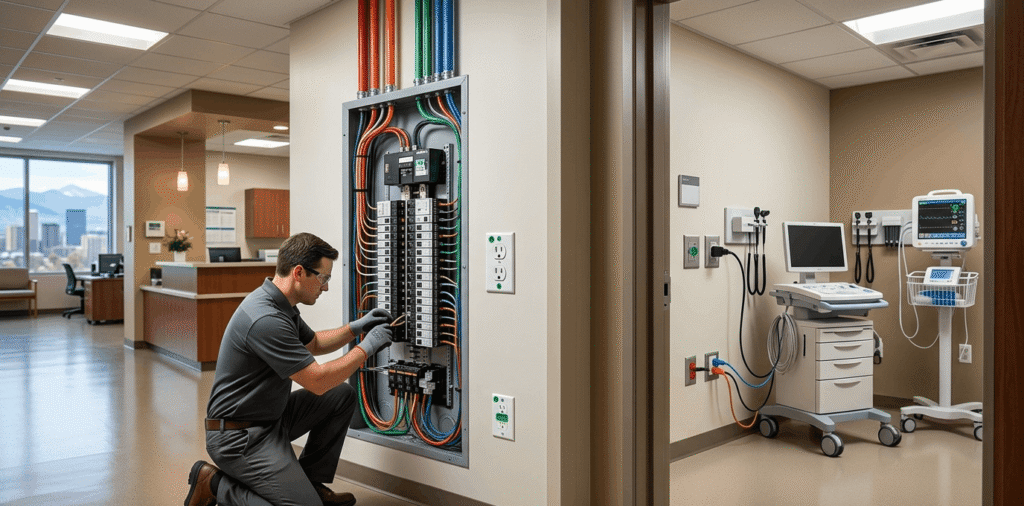
Before opening, Denver medical offices and clinics must comply with NEC Article 517 and NFPA 99. These rules call for special grounding, emergency backup systems, and local power distribution to keep patients safe. The Denver Fire Department and the Colorado Division of Fire Prevention and Control enforce these detailed electrical requirements.
Hiring an experienced commercial electrician in Denver helps your facility meet these special installation and inspection standards safely. A specialist will make sure your power systems are secure, your inspections go smoothly, and your medical space is reliable and up to code.
Why Healthcare Electrical Requirements Are Different from Standard Commercial
Medical electrical systems focus on keeping patients safe and supporting life-saving equipment, rather than just running the building.
- Serious Patient Risks: If the power goes out, life-support machines, patient monitors, and surgeries can stop right away, putting patient safety at risk within seconds.
- Strict Code Classifications: NFPA 99 and NEC Article 517 sort medical spaces into four risk levels, depending on how a power outage would affect patient care.
- High-Risk Infrastructure: Category 1 areas, like operating rooms and ICUs, need a Type 1 Essential Electrical System that is divided into three protective branches.
- Lower-Risk Standards: Category 3 spaces, like exam rooms, still need special healthcare-grade grounding and equipment, even though they have fewer backup power requirements.
Understanding these important differences helps keep your medical facility safe and fully compliant with local safety rules.
4 Risk Categories for Denver Medical Facilities
Denver healthcare facilities are grouped by risk levels set by NFPA 99. A professional commercial electrician uses these categories to decide what kind of emergency power and electrical system your facility needs.
| Category | Risk Level | Typical Spaces | Code Requirement |
| Category 1 | Critical, failure can cause death | OR, ICU, angiographic labs, cardiac cath labs | Type 1 EES (3 branches required) |
| Category 2 | General, failure may cause minor injury | General patient care, nursing stations, dialysis | Type 2 EES (Life Safety and Equipment branches) |
| Category 3 | Basic, failure causes discomfort | Exam rooms, clinics, dental offices, medical offices | Limited EES provisions |
| Category 4 | Minimal, failure unlikely to impact care | Waiting rooms, admin offices, corridors | Standard commercial code |
NEC Article 517 and NFPA 99: What Denver Clinics Must Comply With
All electrical systems in a Denver medical facility must follow two main national standards, which local inspectors enforce closely:
- NEC Article 517 (The Installation Standard): This code covers how electrical systems are built. It sets strict rules for special wiring, strong grounding, and healthcare-grade outlets to prevent electrical shocks in patient care areas.
- NFPA 99 (The Performance Standard): This code covers how systems must work. It sets a four-level risk system based on patient safety and requires certain performance, testing, and maintenance rules for backup generators.
Following these two main rules helps your clinic pass Denver inspections and keeps your patients safe from electrical issues.
Essential Electrical System (EES): The 3‑Branch Structure for Category 1 Facilities
Category 1 healthcare facilities need a Type 1 Essential Electrical System (EES) to keep patients safe and operations running during power outages. NEC Article 517 and NFPA 99 split this system into three separate branches, each supporting different emergency needs.
Life Safety Branch
The Life Safety Branch provides power for emergency lights, exit signs, fire alarms, and emergency communication systems. These circuits must switch over right away if the power fails, so people can evacuate safely and emergency teams can respond quickly.
Critical Branch
The Critical Branch powers things like task lighting, nurse call systems, medication prep areas, pharmacy systems, fixed medical equipment, and outlets in operating rooms. These circuits help make sure patient care continues without interruption during emergencies.
Equipment Branch
The Equipment Branch supplies power to central suction, compressed air systems, sump pumps, smoke control systems, kitchen fire hoods, and certain elevators. Each branch usually needs at least one automatic transfer switch to make sure emergency power is distributed reliably.
Splitting power into three branches keeps important equipment working and makes sure there is safe lighting during a blackout.
Backup Power Requirements for Denver Medical Offices and Clinics
Type 2 healthcare environments operate with a lower patient risk level and utilize an emergency power system consisting strictly of the Life Safety and Equipment branches. While these facilities omit the Type 1 Critical branch, dependable backup power remains necessary for operational continuity and occupant protection.
UPS systems are a good idea for data-sensitive equipment like EHR servers, imaging machines, and communication systems. Denver medical offices should plan for backup power during the design phase, since adding it later is harder and costs more.
Electrical System Designs for Specific Medical Practices
Different medical setups require unique electrical designs based on patient risk. Our skilled team at MV Power Solutions handles these varied layouts with clear project management.
Common requirements include:
| Clinic Type | Key Electrical Requirements |
| Primary Care / Family Medicine | Standard circuits, exam room receptacles, EHR data infrastructure, basic backup power |
| Dental Office | Isolated circuits for dental equipment, NEC Article 517 exam room provisions, compressed air electrical hookups |
| Ambulatory Surgical Center (ASC) | Category 1 spaces, Type 1 EES with 3 branches, isolated power in procedure rooms |
| Imaging / Radiology | Dedicated high-capacity circuits for MRI/CT, lead-lined wall penetration sealing, UPS for scanners |
| Urgent Care Clinic | Dual-source redundancy recommended, Category 2+ provisions, 24/7 operational reliability |
| Medical Office Building (Multi-Tenant) | Per-tenant metering, shared EES for common areas, scalable capacity for future tenants |
What to Look for in a Denver Commercial Electrician for Healthcare Projects
Healthcare construction needs special expertise because of strict safety rules. It’s important to find a contractor who knows NEC Article 517, NFPA 99, and local permit requirements for a successful project.
Key qualifications to evaluate include:
- Code Expertise: Deep knowledge of patient care space requirements and safety standards.
- Relevant Portfolio: Proven experience completing local medical clinics, dental offices, or hospital renovations.
- Specialized Systems: Familiarity with isolated power setups, transfer switches, and backup generator integration.
- Inspection Coordination: History of working smoothly with architects, contractors, and Denver Building & Safety inspectors.
Choosing the right specialist helps you avoid expensive compliance problems, inspection delays, and long-term risks for your facility.
Conclusion
Following Denver’s electrical codes keeps your office safe and compliant. Deciding on your risk category and backup systems early protects both your patients and your budget. MV Power Solutions can help you meet NEC Article 517 and pass inspections. With good planning, your clinic will have a solid foundation, so your team can focus on great patient care.
FAQs
Do small Denver medical offices need to follow NEC Article 517?
Yes. Any Denver facility for patient examination, diagnosis, or treatment must comply with NEC Article 517. Category 3 covers small clinics and dental offices and requires healthcare-grade grounding and receptacles.
Do dental offices in Denver need backup generator power?
Standard Category 3 dental offices operate safely without a full backup generator, though backup power is highly recommended for digital records. Facilities that perform sedation or complex treatments often require more stringent emergency power requirements.
What permits are required for a medical office electrical build‑out in Denver?
Projects require electrical permits from Denver’s building authorities before construction. Plans undergo reviews evaluating emergency systems and life-safety compliance, alongside coordination with the fire department and the state health section.