
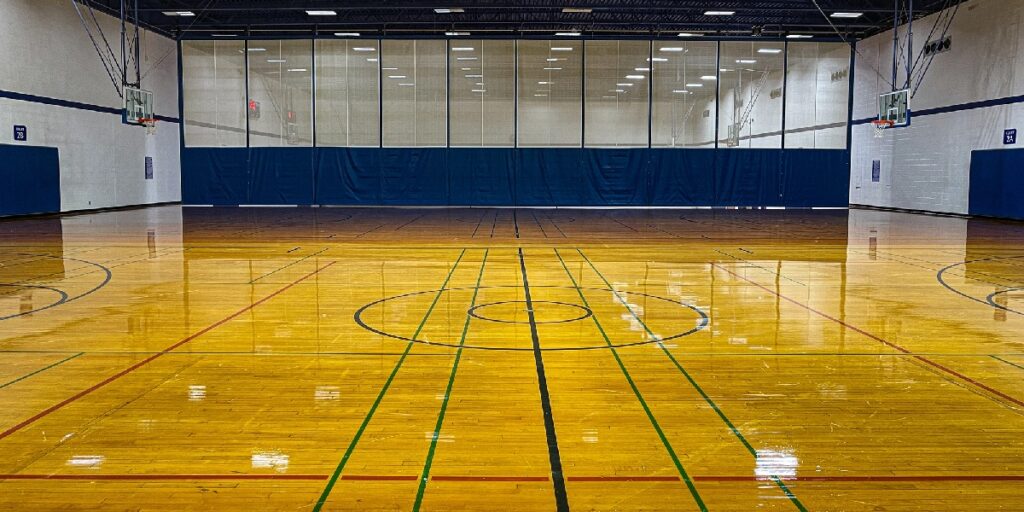
Lighting a gymnasium or auditorium is one of the more demanding challenges in commercial electrical work. These are high-visibility spaces that serve a wide range of functions, often simultaneously: athletic competition and practice, performances, assemblies, graduations, community events, and more. The lighting system has to perform well under all of those conditions, hold up in a high-ceiling, high-use environment, and do it all without driving energy costs through the roof.
For school districts, universities, community centers, and private facilities managing these spaces, getting the lighting right is worth understanding before the project begins.
Why Gymnasium and Auditorium Lighting Is a Specialized Challenge
Most commercial spaces have a relatively consistent lighting requirement. For instance, offices need good task lighting, retail spaces need bright, flattering illumination, and warehouses need sufficient coverage for safe operation. Gymnasiums and auditoriums are different because their requirements shift depending on how people are using the space.
A gymnasium hosting a varsity basketball game needs a very different lighting setup than the same gym teaching a morning PE class or an evening community meeting. An auditorium hosting a theatrical performance has fundamentally different lighting demands than one hosting a school assembly or a board presentation. The school’s lighting system has to handle all of it, plus handle it well.
High ceiling heights add another layer of complexity. Most gymnasiums have ceilings ranging from 24 to 40 feet, and auditoriums vary widely depending on the facility. Lighting fixtures need to be selected for both the mounting height and the specific performance requirements of the space, with enough intensity to adequately illuminate the floor or stage without creating glare or hotspots that affect visibility.
Performance Requirements: What Good Gymnasium Lighting Looks Like
For athletic facilities, lighting performance is directly tied to safety and the quality of the experience for athletes, officials, and spectators. The key metrics are foot-candles—a measure of how much light reaches the playing surface—and uniformity, which describes how consistently that light moves across the space.
For recreational and practice use, lower foot-candle levels are generally acceptable. For competition, particularly at the high school, collegiate, or professional level, higher foot-candle requirements apply, and some governing bodies publish specific standards for televised or recorded events. A lighting system that meets practice requirements but falls short of competition standards is a problem that surfaces at the worst possible time.
Color rendering is also worth attention. LED fixtures vary in their ability to render colors accurately, and in a gymnasium context, good color rendering affects how the court markings, uniforms, and signage appear both to those in the space and on camera.
For auditoriums, the performance requirements shift toward controllability. A well-designed auditorium lighting system includes stage lighting, house lighting, and often emergency and aisle lighting. All of these need to be independently controllable and capable of creating different atmospheres for different events. Dimming capability, color temperature options, and programmable scene control should all be included in the earliest design conversations.
Efficiency: The Long-Term Case for LED
The high ceiling heights that define gymnasiums and auditoriums used to mean one thing: metal halide or fluorescent high-bay fixtures that consumed significant amounts of energy, required frequent relamping, and took 15 to 20 minutes to warm up to full brightness. LED technology has changed that equation dramatically.
Modern LED high-bay fixtures designed for gymnasium and auditorium applications deliver the foot-candle levels and uniformity that these spaces require at a fraction of the energy consumption of legacy systems. Typical energy savings from an LED retrofit in a gymnasium range from 50 to 70 percent compared to metal halide. The savings are significant when you consider how many hours these spaces are in use each day.
LED fixtures also eliminate the warm-up delay, dramatically reduce maintenance requirements, and have rated lifespans measured in decades rather than years. For facility managers managing tight maintenance budgets and demanding schedules, those operational benefits are as valuable as the energy savings.
Adding occupancy sensors, daylight harvesting controls, and programmable lighting controls to an LED system takes the efficiency gains further. These lighting systems can automatically dim or shut off when spaces are unoccupied and adjust brightness based on available natural light.
Getting the Design Right From the Start
The performance and efficiency goals of gymnasium and auditorium lighting can be met with thoughtful design, the right fixture selection, and installation by a contractor who understands these environments. A lighting layout that looks good on paper but produces glare, dark spots, or insufficient foot-candles on the floor is a problem that’s expensive to correct after the fact.
At MV Power Solutions, we work with schools, universities, community centers, and private facilities on gymnasium and auditorium lighting projects, from initial design and fixture selection through installation and controls programming. If you’re planning a new installation, considering an LED retrofit, or evaluating a space that isn’t performing the way it should, reach out to our team today at 720-287-2305 or fill out our contact form.